

Recently, while walking down Oxford Street in London, I came across this event from a familiar name:
Vercel.
The billboard said: Agentic Infrastructure.

That phrase stayed with me.
Because Vercel is a very good example of an old business lesson:
During the gold rush, sell shovels.
This is the first in a series of mini case studies I’ll be writing on AI products and AI-era companies.
In the coming weeks, I’ll cover companies and products like Cursor, Lovable, PostHog, NotebookLM, Antigravity, Wispr Flow, and more,
The goal is simple:
Not just to understand what these products do, but to understand the deeper product and business lessons behind them.
Why did they work?
What behaviour change are they riding?
What can founders, PMs, operators, and builders learn from them?
Let’s start with Vercel.
1. The simple idea
AI has made it easier to write code.
But writing code is not the same as shipping software.
After the code is generated, someone still has to answer the boring but important questions:
Where will this app live?
How will it be deployed?
How will the team review changes?
How will it scale?
How will it stay fast?
How will we monitor it?
That is where Vercel sits.
Vercel is not just benefiting because developers are using AI.
It is benefiting because AI is creating more people who behave like developers.
Founders are building.
PMs are building.
Designers are building.
Small teams are building internal tools.
Non-technical operators are experimenting with prototypes.
And once they build, they all hit the same wall:
“How do I put this in production?”
That is the shovel.
2. Quick history
Vercel did not start as an “AI company.”
It started as ZEIT, a developer infrastructure company focused on making deployment simpler.
In 2020, ZEIT rebranded to Vercel and sharpened its focus around the workflow of:
Develop → Preview → Ship
A big part of Vercel’s rise also came from its relationship with Next.js, the React framework maintained by Vercel.
For many modern web teams, Vercel became the default-feeling place to deploy frontend apps, especially Next.js apps.
Over time, Vercel moved from being “easy deployment for frontend developers” to something broader:
A cloud platform for modern web apps, AI apps, and now agentic software.
That is why the phrase Agentic Infrastructure is interesting.
It signals that Vercel does not want to be seen only as a hosting company.
It wants to become the infrastructure layer for the next generation of AI-native applications.
3. What Vercel actually provides
While vibe-coding platforms like Claude Code, Lovable, Google AI Studio, Emergent help people build products, Vercel does something no one wants to touch!
For someone building software, Vercel solves many of the annoying parts after the code is written:
Deployment
Push your code and get a live URL.
Preview links
Every change can get its own preview URL, making review and collaboration easier.
Hosting and performance
Apps can be served globally without teams manually managing infrastructure.
Serverless functions
Teams can run backend logic without maintaining traditional servers.
Deployment environments
Separate production, preview, and development workflows.
Observability and analytics
Teams can understand performance, usage, errors, and real-world behaviour.
AI-native tooling
Vercel also has tools like v0 and AI SDK, which help builders create AI-powered web products faster.
Every vibe coding tool allows you to get the github repo of your product and Vercel safely takes over from there,
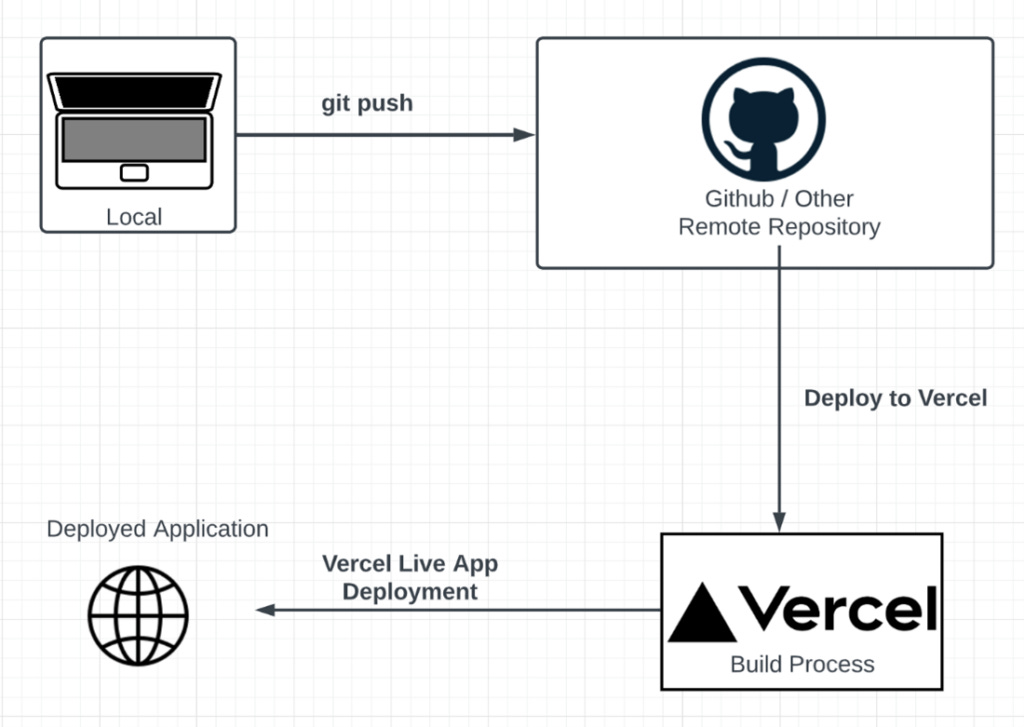
That last part matters.
Vercel is not just hosting the old web.
It is trying to become infrastructure for the AI-native web.
4. Why this is a strong AI-era business case
Most people look at AI and ask:
“What new AI tool can I build?”
But the deeper question is:
“What behaviour does AI increase?”
AI increases software building.
So deployment infrastructure becomes more valuable.
AI increases content creation.
So editing, publishing, and distribution tools become more valuable.
AI increases research.
So knowledge management and source-verification systems become more valuable.
AI increases automation.
So workflow and integration platforms become more valuable.
This is the second-order effect.
The winner is not always the company closest to the shiny new behaviour.
Sometimes the winner is the company that supports what happens immediately after that behaviour explodes.
5. The takeaway
Vercel’s opportunity was not created overnight by AI.
It had already built trust with developers, Next.js users, startups, and modern web teams.
AI simply expanded the market.
More builders means more apps.
More apps means more deployments.
More deployments means more need for infrastructure.
More agentic apps means a new kind of infrastructure layer.
That is the real lesson.
Don’t just look at what AI can do.
Look at what AI makes people do more of.
That is where new markets appear.
And often, that is where the best shovel businesses are built.
During the gold rush, sell shovels.
Vercel is a saviour for many medium to small scale IT firms. Great Knowledge Sharing !